
 /
/ 

When seagrass beds hide the best positions
Let's take the example of the Glénan archipelago to illustrate this point, even though it's vala ble in other areas too. There, the long brown algae called Thongsweed form vast fields among which are patches of sand.

Camouflaged in the sea grass, sea bass lie in wait for the slightest prey passing over the clear zone. This contrast favors their visual detection by predators. Sand patches thus become the areas to target.
Spot the right sand spots
Not all sandy areas are created equal. Small, isolated patches are the most interesting. On these small surfaces, the predator remains close to the attack zone, yet perfectly hidden.
There are several ways to identify these areas:
- Satellite views: available online, these give an overview of the seabed's configuration. Beware, however, that storms regularly modify these sandy areas.
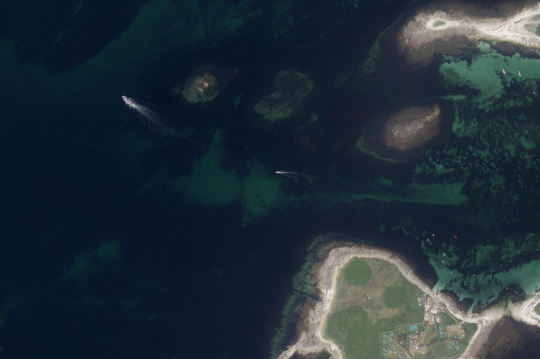
Use satellite images to pinpoint the best areas. - Navigation observation: by standing on the bolster and moving forward slowly, with polarized glasses on your nose, you can easily distinguish the contrasts between sand and seaweed. Each spot spotted can then be recorded on the GPS for future use.

Approach with finesse and silence
In these areas, depths are relatively shallow, generally not exceeding 7 meters. The key to success lies in the discretion of the approach. Never pass directly over the task. Position yourself upstream, according to the wind and current, then drift slowly towards the target area.

Choosing the right technique and equipment
This technique requires a certain amount of mobility, as you have to move from one task to another. As a rule, I don't make more than 5 casts in the same spot before changing position. If the fish are present, the bites will come quickly.
For this, I use lures that are deliberately heavier than usual, depending on the fishing conditions. For example, in 5-metre depths, I prefer lure/head sinker sets weighing less than 10 g. On the other hand, in these specific areas, I choose 20 to 30 g sets, depending on wind strength. The aim is to make accurate casts while guaranteeing a rapid descent of the lure without leaving a banner.

Fiiish's Crazy Sand Eel is a sure bet for this type of fishing, imitating the sandeel often found in these biotopes.
As soon as the lure hits the bottom, I make a quick retrieve. Overloading a lure also generates a cloud of sand on impact with the bottom, which attracts more predators nearby. I've noticed that the weight of the sinker has a clear influence on the results.
Depending on the season, I vary my selection of lures, which generally consists of three models:
- crazy Paddle Tail 120/150.
- crazy Sand Eel120/150.
- black Minnow 120.
I also use a long leader, about 3 metres long, for more discretion, choosing 27/100 fluorocarbon for optimum stealth.
Recommended equipment
For the rod, a 2.20 m model with 10/30 g of power, combined with a 3000-size reel, is perfect. It's important to pay attention to the resonance of the rod to know precisely when the lure hits the bottom. The rod must also offer enough power to control a fish once hooked. The area is crowded, so if a sea bass manages to wrap itself in the seaweed, the risk of breakage is high.


