
 /
/ 

Triple hook VS single hook: the match
Each has its advantages and disadvantages.
Triple hooks are almost always used with original lures, not least because of their excellent success rate when hooked. With their three points, they significantly increase the chances of hooking the fish at the moment of attack.
However, they also have several disadvantages. They can injure fish more, snag more easily in obstacles and make unhooking more delicate. For these reasons, many anglers opt to replace them with single hooks.
When it comes to discretion, treble hooks aren't the most efficient either. They can generate more noise, which can be detrimental to the success of some sessions, especially when fish are wary.
Lastly, they tend to wear down lure varnish more quickly due to repeated rubbing.

Single hooks are not usually fitted as standard, although more and more brands are starting to offer them.

They have several advantages: they hook less easily in obstacles, are lighter and offer less resistance in the water, which generally favours a more natural swimming action of the lure. They also preserve the lure's aesthetic appeal, a point not to be underestimated by those who attach importance to it.
Like all equipment, they also have their limits. The most common complaint concerns a potential lack of efficiency when hooking. To remedy this, choosing the right hook size is crucial.
Single and treble hooks: how to make the right match?
When you want to replace a treble hook with a single hook, it's not enough to rely on the size number. In fact, a single hook with the same size number as a treble may have a different opening and weight.
Generally speaking, a single replacement hook must meet several criteria:
- an opening close to that of the triple,
- a length adapted to the lure,
- a similar weight, so as not to unbalance its stroke.
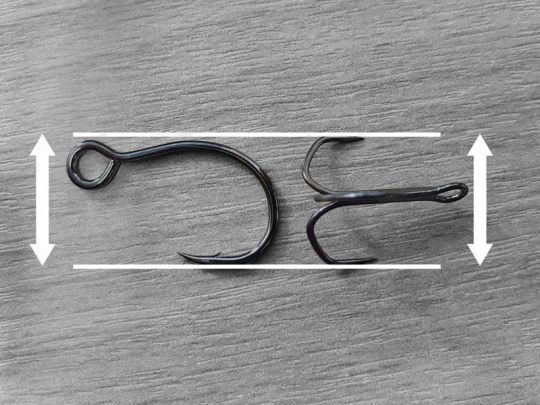
It's important to consider the size of the treble hook before replacing it with a single hook.

Simple size matching

These correspondences are only indicative. They may vary according to hook shape, brand or type of lure used.
Points to check before changing hooks
Before replacing a treble hook with a single one, there are several points to consider.
The first concerns the lure's balance: a heavier or lighter hook can alter its swimming action. On a swimming fish, and particularly on a suspending model, this can have a major impact. It is therefore preferable to stay as close as possible to the original weight.
The orientation of the hook also plays an essential role. Depending on its position on the lure, it should be mounted pointing upwards or backwards to limit snagging while maintaining good striking efficiency.

Care must also be taken to ensure that the hook retains sufficient freedom of movement. It must not interfere with the lure's swimming action, nor risk becoming entangled in its body or with another hook.
Finally, regulations must not be overlooked. On some courses, the use of single barbless hooks is mandatory.
So why change?
The single hook offers several advantages, depending on the situation. They are particularly well-suited to no-kill fishing, where they make catch-and-release easier by limiting the number of injuries inflicted on the fish. They are also very useful in congested areas.

On routes subject to specific regulations, in particular where single barbless hooks are mandatory, it simply becomes indispensable.
Finally, the single hook also reduces the risk of self-injury, a significant advantage when handling fish.


